Modern manufacturing demands components that deliver exceptional accuracy, long service life, and dependable performance.Unlike conventional assemblies, these engineered solutions are manufactured to exact specifications, enabling multiple components to work together seamlessly while maintaining dimensional accuracy and consistent performance.
As industries continue to adopt automation and high-performance machinery, the need for reliable precision machined assemblies has grown significantly. Every micron matters because even the slightest deviation can affect the functionality of an entire system. Companies investing in advanced CNC machining, quality inspection, and engineered manufacturing processes are helping OEMs improve product quality, reduce downtime, and optimize operational efficiency.
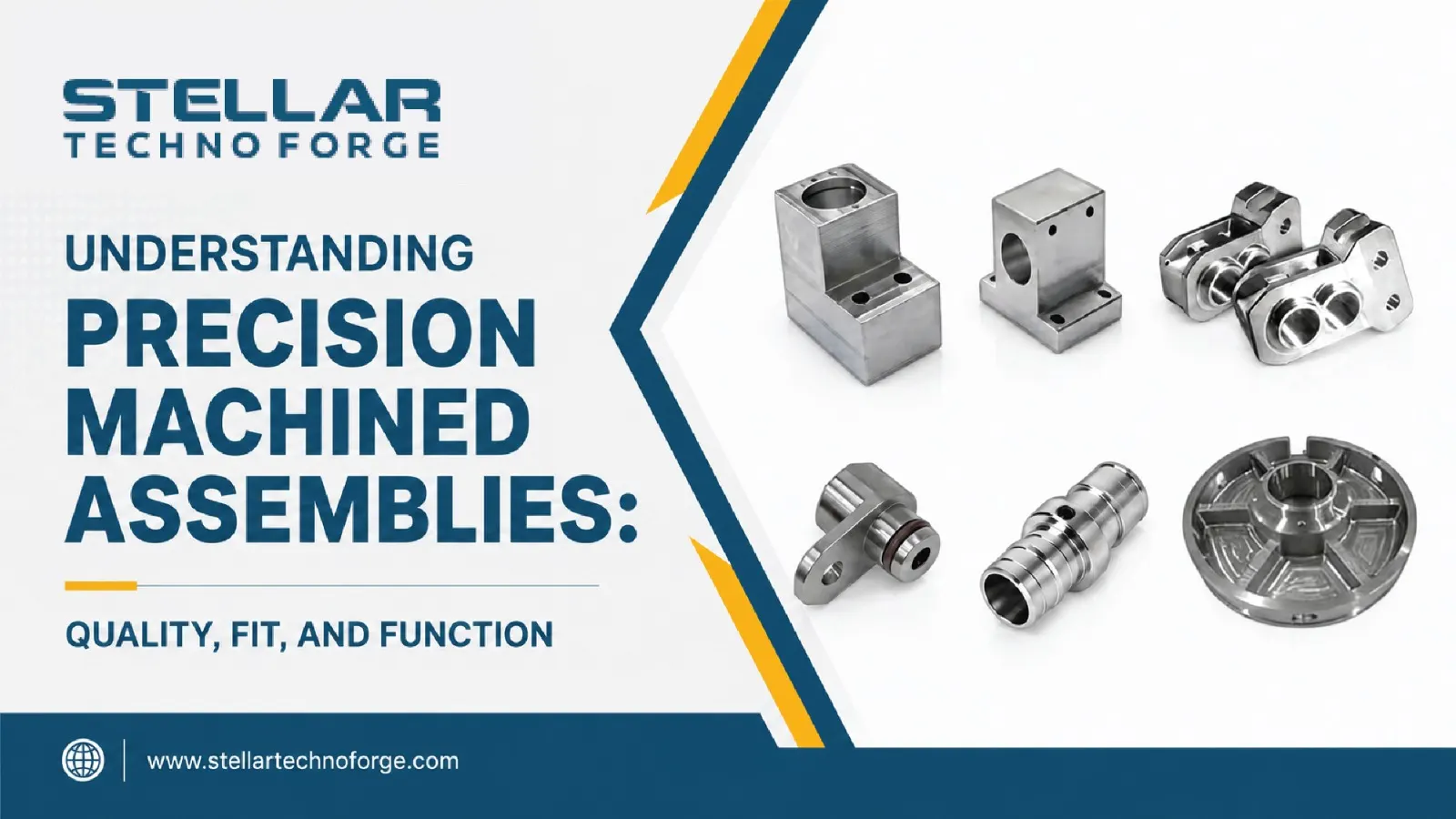
Precision machined assemblies refer to a collection of accurately manufactured components that are machined, inspected, and assembled to function as a single mechanical unit. These assemblies often consist of shafts, housings, gears, flanges, pins, bushings, and other engineered components produced through CNC machining, forging, casting, or bar stock manufacturing.
Every assembly is designed to perform a specific function. Individual components are manufactured with tight dimensional tolerances before being integrated into a finished assembly. Since every part must fit perfectly with its mating components, manufacturers rely on advanced CNC turning, milling, drilling, and finishing operations to achieve repeatable accuracy.
Precision assemblies are essential across numerous industries, including:
These industries demand high reliability because component failures can result in expensive downtime and safety concerns.
Quality is the foundation of every successful precision machined assembly. High-quality components not only meet dimensional requirements but also deliver superior durability, wear resistance, and long-term reliability.
The manufacturing process begins with selecting the appropriate material based on application requirements. Carbon steel, alloy steel, stainless steel, forged blanks, castings, and bar stock are commonly used depending on strength, corrosion resistance, and load-bearing requirements.
Modern manufacturers combine advanced machinery with strict process controls to ensure consistent quality throughout production. According to Stellar Techno Forge, its manufacturing capabilities include machining components from forgings, castings, and bar stock while maintaining stringent quality standards for multiple industrial sectors.
Quality assurance extends beyond machining. Every component undergoes dimensional inspection, surface finish evaluation, and functional verification before assembly. Manufacturers often employ coordinate measuring machines (CMMs), gauges, and customized inspection fixtures to ensure every component complies with engineering drawings.
The "fit" in precision machined assemblies determines how effectively components interact. Poor fit can create vibration, premature wear, leakage, excessive friction, or even catastrophic failure.
Modern CNC machining enables manufacturers to achieve extremely tight tolerances. Advanced machining centers ensure consistent production with minimal variation across batches.
| Factor | Standard Machining | Precision Machining |
|---|---|---|
| Accuracy | Moderate | Extremely High |
| Repeatability | Limited | Excellent |
| Surface Finish | Average | Superior |
| Assembly Performance | Variable | Consistent |
| Scrap Rate | Higher | Lower |
Several factors influence assembly quality:
By controlling these variables through modern manufacturing techniques, precision manufacturers significantly improve assembly consistency and operational reliability.
Precision alone has little value unless components perform reliably under real-world operating conditions.
Well-designed precision machined assemblies reduce friction, improve alignment, and distribute loads more evenly. This minimizes wear while extending equipment life.
Applications such as hydraulic pumps, steering systems, transmission components, industrial valves, and heavy machinery require assemblies capable of operating continuously under high loads. High dimensional accuracy ensures smooth movement and predictable performance throughout the product lifecycle.
Manufacturers benefit from precision assemblies because they reduce maintenance costs, simplify installation, and minimize production interruptions. Components manufactured consistently also make inventory management and replacement easier, particularly for OEMs operating global supply chains.
Producing high-quality precision machined assemblies requires advanced manufacturing technologies supported by experienced engineering teams.
Today's manufacturers employ:
Stellar Techno Forge operates multiple CNC turning centers, vertical machining centers, and conventional machining equipment capable of producing precision components across diverse industrial applications.
Manufacturers select the production method based on strength, geometry, and application requirements.
| Manufacturing Method | Primary Advantage |
|---|---|
| Forging | High mechanical strength |
| Casting | Complex geometries |
| Bar Stock Machining | Excellent dimensional accuracy |
Combining forging with precision machining provides enhanced grain structure while delivering exceptional dimensional control.
Selecting the right manufacturing partner has a direct impact on product quality, lead time, and production costs.
When evaluating suppliers, consider:
A manufacturer should also support prototype development, production ramp-up, and value engineering to optimize cost without compromising quality.
For businesses seeking dependable precision machined assemblies, Stellar Techno Forge offers a combination of engineering expertise, advanced manufacturing, and customer-focused solutions.
Key strengths include:
These capabilities enable the company to deliver reliable precision components tailored to demanding industrial applications.
Manufacturing continues to evolve through Industry 4.0 technologies. Smart factories now integrate CNC automation, AI-assisted process monitoring, predictive maintenance, and digital inspection systems to improve quality while reducing production costs.
Manufacturers are also investing in sustainable operations, energy-efficient machining, and environmentally responsible production practices. These developments help organizations achieve higher productivity while meeting increasingly stringent environmental standards.
As global OEMs demand faster lead times and greater manufacturing flexibility, suppliers capable of combining advanced machining technology with engineering expertise will remain competitive.
Precision machined assemblies represent far more than accurately manufactured parts—they are engineered systems designed to deliver exceptional quality, perfect fit, and reliable function. From selecting premium raw materials to applying advanced CNC machining and rigorous quality inspection, every stage contributes to the final performance of the assembly.
Businesses that partner with experienced manufacturers gain improved product reliability, reduced maintenance costs, and consistent production quality. Companies like Stellar Techno Forge continue to demonstrate how advanced machining capabilities, engineering excellence, and sustainable manufacturing practices create long-term value for customers across multiple industrial sectors. Whether your application involves automotive systems, hydraulic equipment, agricultural machinery, or heavy engineering, investing in precision machining is an investment in performance, reliability, and future-ready manufacturing.