When it comes to manufacturing metal components, not all machining methods are created equal. Whether you are an engineer sourcing parts for a critical application or a procurement manager evaluating suppliers, understanding the difference between precision machining and traditional machining can have a direct impact on how well your end component performs, what it costs to produce, and whether it meets the standards your application demands.
In this blog, we break down both approaches — what they are, how they differ, and why more industries are making the shift toward precision machining for demanding, high-performance applications.
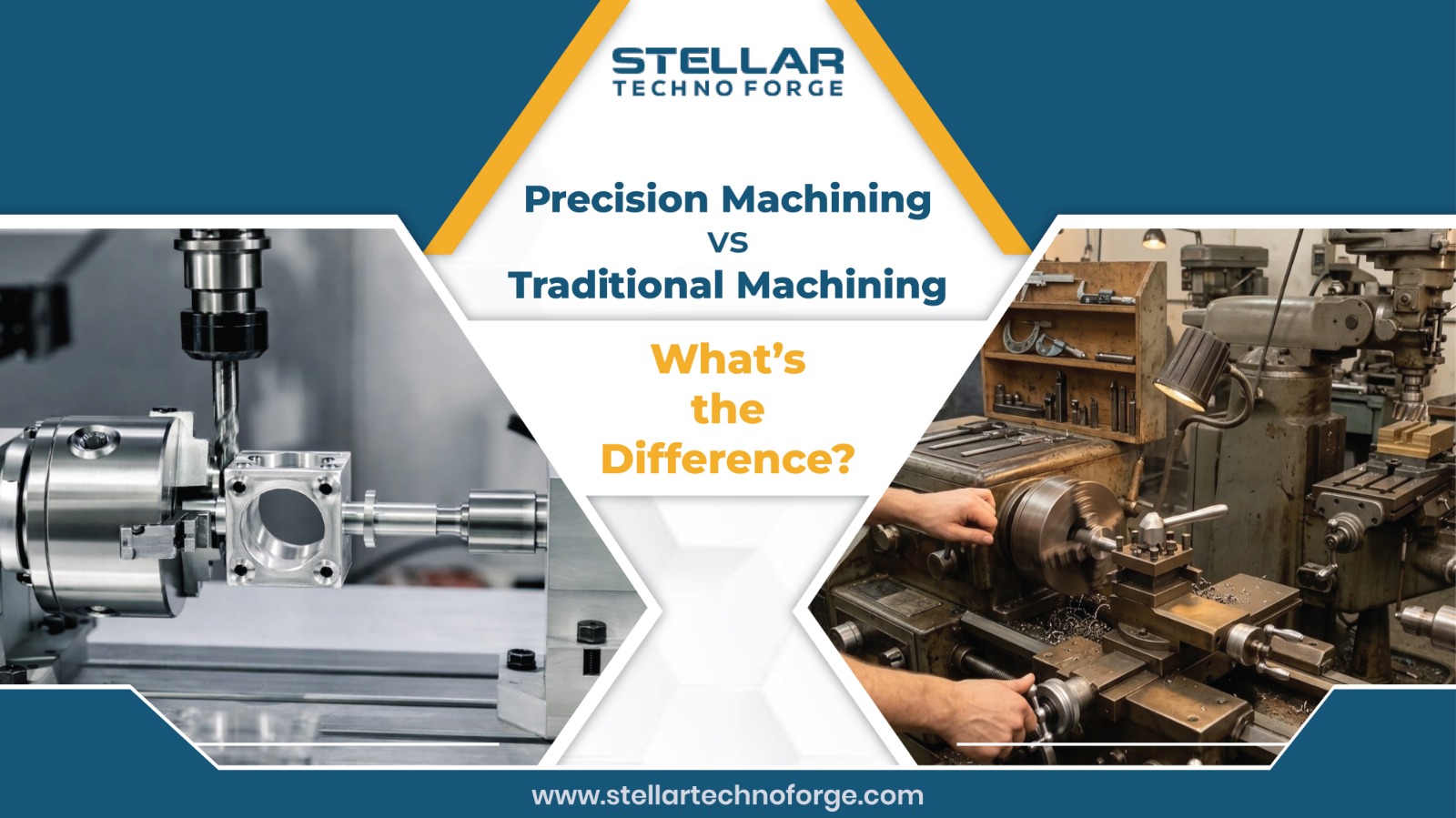
Traditional machining refers to conventional manufacturing processes that have been used for decades. These include manual turning, milling, drilling, and grinding — typically operated by skilled machinists using manually controlled or semi-automated machines.
In traditional machining, the machinist controls the cutting tool and workpiece by hand or through basic mechanical controls. This approach works well for simple components, low-volume production runs, or situations where tight tolerances are not critical. However, it is inherently limited by human precision and machine capability.
Key characteristics of traditional machining include:
Precision machining is an advanced manufacturing process that uses computer-controlled equipment — most commonly CNC (Computer Numerical Control) machines — to produce components with extremely tight tolerances and high dimensional accuracy.
Modern precision machining can consistently achieve tolerances as tight as ±0.001 mm or even finer, depending on the application and material.
At Stellar Techno Forge, precision machining is at the heart of everything we do. With over 40 years of manufacturing experience and state-of-the-art CNC machining capabilities, we produce components that meet the most stringent quality and dimensional requirements across industries ranging from automotive and agriculture to oil & gas and hydraulics.
Key characteristics of precision machining include:
Let us compare the two approaches across the parameters that matter most to manufacturers and procurement teams:
Precision machining consistently delivers tight dimensional tolerances that traditional machining simply cannot match. In high-stakes industries like hydraulics, oil and gas, or automotive, even a fraction-of-a-millimeter deviation can result in component failure or assembly issues. Traditional machining is adequate for general applications, but it is not designed for this level of dimensional control.
Where precision machining truly sets itself apart is in how reliably it reproduces the same result, run after run. Because CNC programs control every movement with mathematical accuracy, each part produced is virtually identical to the last — whether you are manufacturing 10 parts or 10,000. Traditional machining introduces variability from one piece to the next, making it less suitable for large-volume production where uniformity is essential.
Precision CNC machines can operate continuously with minimal downtime, significantly reducing cycle times on complex components. Traditional machining requires more manual setup and adjustments between operations, which increases lead times and limits throughput, particularly for intricate or multi-featured parts.
Precision machining supports a wide range of materials — from carbon steel and alloy steel to stainless steel, aluminium, brass, and exotic alloys such as Inconel and Monel.
Traditional machining is more limited in this regard, especially when working with hard or heat-resistant materials that demand specialised cutting strategies and tightly controlled parameters.
Traditional machining may appear more affordable upfront, particularly for simple, low-volume jobs. However, when you factor in the cost of scrap, rework, and quality failures, precision machining often proves more economical over the full production lifecycle — especially at scale. Precision machining reduces the overall cost of quality by getting components right the first time, every time.
Precision machining has become the standard in any sector where component performance, safety, and long-term reliability are non-negotiable. These include:
Stellar Techno Forge serves all of these sectors and more — delivering over 550 precision-engineered products for 50+ customers worldwide, supported by an ISO-certified quality management system and decades of forging and machining expertise
The difference between precision machining and traditional machining is not just technical — it is strategic. As manufacturing demands grow more complex and tolerances tighter, the ability to produce components with exceptional accuracy, repeatability, and consistency becomes a true competitive advantage.
Traditional machining still has its place for simpler, lower-stakes applications. But for industries where quality, safety, and long-term reliability are critical, precision machining is the clear and logical choice. With four decades of combined expertise in both forging and precision machining, Stellar Techno Forge is equipped to deliver components that meet your most demanding specifications — from design through to delivery.
Whether you are looking to optimise your supply chain, improve component quality, reduce waste, or scale production efficiently — the right precision machining partner makes all the difference.