In precision manufacturing, getting a part to the right shape is only half the battle. The real test is whether that part actually meets the specifications it was designed to. That's where inspection comes in — and for companies operating in industries where tolerances are measured in microns, inspection isn't just a checkbox. It's a commitment to quality.
At Stellar Techno Forge,with over 40 years of experience in precision machined components, quality inspection is woven into every stage of production — from raw material receipt to final dispatch. This blog breaks down the essential inspection methods used for precision machined parts, why each one matters, and how they work together to ensure zero-compromise quality.
Precision machined parts are used in critical applications — automotive systems, hydraulic assemblies, oil and gas equipment, earth-moving machinery, and more. A component that's even slightly out of tolerance can cause system failures, costly recalls, or safety hazards.
That's why manufacturers rely on a combination of inspection methods — both advanced metrology tools and time-tested visual techniques — to validate every part before it moves to the next stage or ships to the customer. Let's explore these methods in detail.
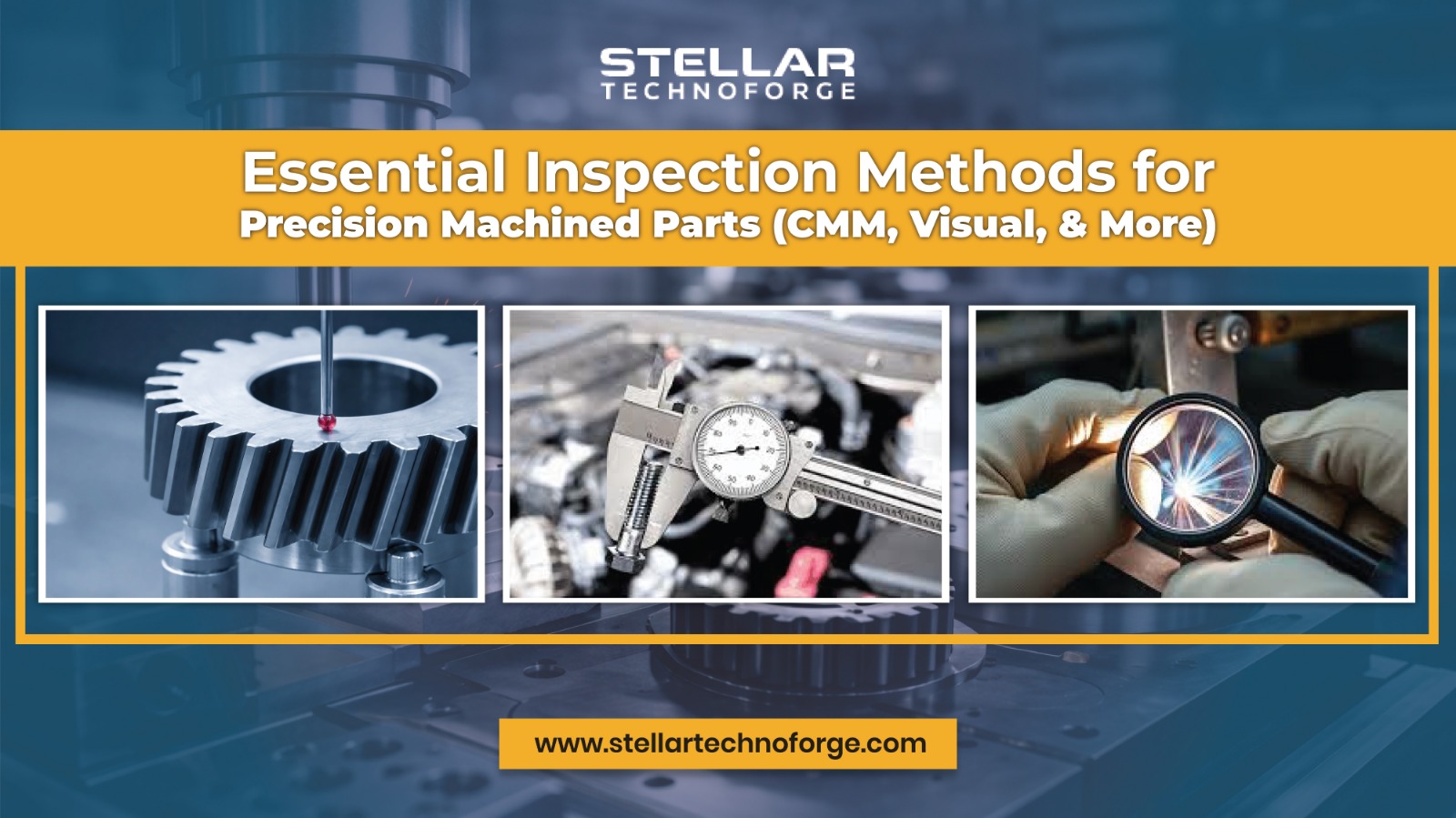
CMM inspection is considered the gold standard in dimensional measurement for precision machined parts. A Coordinate Measuring Machine uses a probe to measure a part's geometry across three axes — X, Y, and Z — generating precise data points that are compared against the CAD model or engineering drawing.
CMM inspection is especially valuable for complex geometries — parts with multiple reference planes, critical bore locations, or tight positional tolerances. At Stellar Techno Forge, CMM inspection is used on components across our product portfolio, from hydraulic cylinder components to precision forged and machined parts for the automotive industry.
Modern CMMs can operate in contact or non-contact modes and are often integrated with software that generates detailed inspection reports, making it easier to trace and resolve any out-of-tolerance conditions quickly.
Often underestimated, visual inspection is one of the most fundamental and cost-effective inspection methods for precision machined parts
Trained quality inspectors examine parts for surface defects that instruments alone may not flag as dimensional failures — but that could still affect performance, finish, or customer acceptance.
Visual inspection is typically the first line of quality control — a fast, experience-driven check before more advanced measurements are taken. Experienced quality teams, like those at Stellar Techno Forge, combine systematic visual checks with inspection aids such as magnifiers, borescopes, and structured lighting to ensure nothing is missed.
Surface finish is critical in precision machined parts — especially for components that will slide, seal, or mate with another surface. Surface roughness, commonly expressed as Ra (arithmetic mean roughness), is measured using a profilometer or surface tester.
Industries like hydraulics and oil and gas are particularly sensitive to surface finish requirements. A rough bore in a hydraulic cylinder, for instance, can compromise seal life and cause leakage. By measuring Ra values, manufacturers ensure each part performs as expected over its entire service life.
For parts that undergo forging or heat treatment — two core capabilities at Stellar Techno Forge — hardness testing ensures the material has achieved the required mechanical properties. Common hardness testing methods include Rockwell, Brinell, and Vickers.
Hardness testing is particularly important for high-stress components such as connecting rods, axle shafts, gears, and earth-moving equipment parts, where material strength directly impacts component longevity and safety.
For precision machined parts that involve threaded features, gauge-based inspection is essential. Go/No-Go gauges are used to verify that threads are within tolerance — they confirm both the minimum and maximum acceptable limits in a simple, fast pass/fail format.
Beyond threads, plain gauges are used to check bore diameters, shaft diameters, and other features with tight dimensional tolerances. This method is widely used on production floors where speed and repeatability are priorities.
For critical components — especially in oil and gas, defense, and high-load structural applications — non-destructive testing methods are used to detect internal or subsurface flaws without damaging the part. Common NDT methods include:
NDT methods are particularly relevant for forged components, where the forging process itself must be validated to ensure no internal defects were introduced during forming.
No single inspection method tells the complete story of a part's quality. The most effective quality systems use a layered approach — combining CMM inspection for dimensional accuracy, visual inspection for surface quality, hardness testing for material integrity, and NDT for internal soundness.
At Stellar Techno Forge, our quality management system integrates these inspection methods across the production workflow. Each batch of precision machined components is subjected to the appropriate combination of tests based on customer requirements, industry standards, and application criticality. This ensures that every part leaving our facility in Rajkot is not only dimensionally accurate but also structurally sound and surface-perfect.
Precision machining is only as good as the inspection that backs it up. Whether it's a CMM verifying complex geometry, a trained inspector catching a subtle surface defect, or NDT confirming structural integrity, every inspection method plays a vital role in delivering parts that perform reliably in the field.
The commitment to rigorous, multi-method inspection is what separates a good manufacturer from a great one. It's what has enabled Stellar Techno Forge to build long-term partnerships with 50+ customers across the globe and develop over 550 products across industries — all backed by four decades of precision engineering expertise
If your components demand zero-compromise quality, understanding how your manufacturer approaches inspection is not just important — it's essential.